Australian Antarctic Program scientists say virus on Heard Island has spread to new species...

Vous n'êtes pas connecté
- English
- Français
- عربي
- Español
- Deutsch
- Português
- русский язык
- Català
- Italiano
- Nederlands, Vlaams
- Norsk
- فارسی
- বাংলা
- اردو
- Azərbaycan dili
- Bahasa Indonesia
- Հայերեն
- Ελληνικά
- Bosanski jezik
- українська мова
- Íslenska
- Türkmen, Түркмен
- Türkçe
- Shqip
- Eesti keel
- magyar
- Қазақ тілі
- Kalaallisut ; kalaallit oqaasii
- Lietuvių kalba
- Latviešu valoda
- македонски јазик
- Монгол
- Bahasa Melayu ; بهاس ملايو
- ဗမာစာ
- Slovenščina
- тоҷикӣ ; toğikī ; تاجیکی
- ไทย
- O'zbek ; Ўзбек ; أۇزبېك
- Tiếng Việt
- ភាសាខ្មែរ
- རྫོང་ཁ
- Soomaaliga ; af Soomaali
Rubriques :
 Maroc - EURASIAREVIEW.COM - A la une - 05/Feb 23:42
Avian Flu Causes Die-Off Of Antarctic Skuas
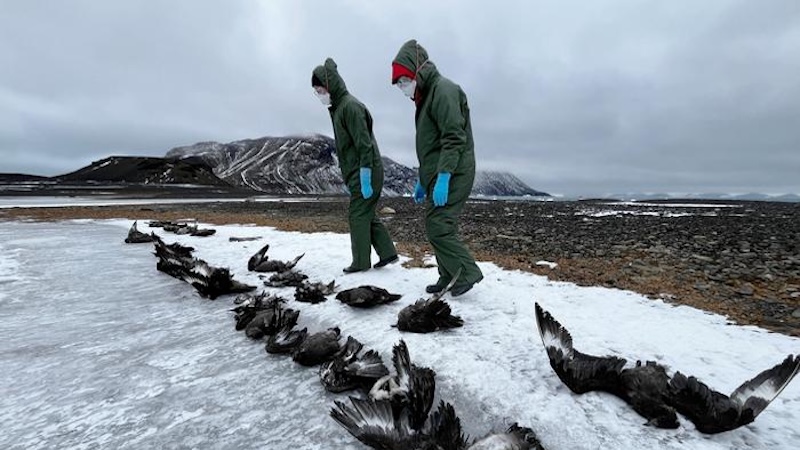
More than 50 skuas in Antarctica died from the high pathogenicity avian influenza virus H5N1 in the summers of 2023 and 2024, marking the first documented die-off of wildlife from the virus on the continent. That is confirmed for the first time in a study led by Erasmus MC in The Netherlands and the University of California, Davis. It published this week in the Nature journal Scientific Reports. A relative of gulls, skuas are predatory, large brown birds living mostly in polar and subpolar environments. Similar to raptors, they play an important ecological role as scavengers. That role could position them to further spread the virus across Antarctica, the report notes. Scientists previously detected the virus in a kelp gull and two skuas in Antarctica found dead in January and February 2024. However, avian flu had not been confirmed as the cause of their deaths. “We knew there were animals with the infection, but this is the first study to show they died of the viral infection,” said co-senior author Ralph Vanstreels, a wildlife veterinarian with the UC Davis One Health Institute within the Weill School of Veterinary Medicine. “It’s an important distinction in the early days of an outbreak.” Expedition to Antarctica In March 2024, the authors traveled to Antarctica on a research expedition shortly after the breeding seasons of skuas and penguins. They surveyed wildlife at 10 locations in the South Shetland Islands, northern Weddell Sea and Antarctic Peninsula. When they found infected or dead wildlife, they collected tissue samples and environmental samples for analysis and performed necropsies. The team found and performed post-mortem examinations on carcasses of gentoo penguins, Adélie penguins and Antarctic fur seals, but H5N1 was not diagnosed as the cause of death of those animals. “As the expedition progressed, it became obvious quickly that skuas were a major victim,” said Vanstreels. The team detected H5N1 in skuas at three locations – Hope Bay, Devil Island and Beak Island, which experienced a mass die-off of south polar skuas. “We diagnosed high pathogenicity avian influenza as the cause of death for nearly all of the dead skuas we found at Beak Island,” said first author Matteo Iervolino, a Ph.D. candidate at Erasmus MC in Rotterdam, The Netherlands. “There, I could really see with my eyes the impact this virus can have on these populations.” Vanstreels called it a “crisis in animal suffering.” The virus hits the brain, causing neurological symptoms, like a twisted neck or abnormal stretching. The birds swim or walk in circles. Sometimes they stumble blindly into an object or fall out of the air. The authors emphasize that humans are partly responsible for the virus and for preventing its spread. History and spread of H5N1 H5N1 virus was discovered in 1996 in Southeast China on a domestic goose farm. It went uncontrolled within the poultry industry for several years, during which it spilled over into wild birds and then spread to Europe, the Middle East, Africa and later to North America, South America and, in early 2024, to Antarctica. The same lineage of virus now affecting Antarctic skuas previously decimated elephant seals and sea lions in Argentina, led to the loss of more than 400 million poultry, and has affected dairy cows, mink, foxes, bears, otters and many other mammals and wild birds. It can also spread to people. About half of the approximately 1,000 people infected with the virus died. “We let the virus slip out through our fingers when it first emerged in the poultry industry,” said corresponding senior author Thijs Kuiken, a professor at Erasmus MC. “Once it got into wild bird populations, we lost ability to control this virus. Now it’s established in wild bird populations in all the continental regions of the world except Oceania.” More surveillance needed to prevent spread Wildlife in Antarctica already face a harsh environment and many threats, from global warming and increased tourism to invasive species, overfishing and pollution. Avian influenza creates an additional stressor requiring further surveillance and monitoring to help prevent future spillover, the study said. For example, the last census of skuas in Antarctica was conducted in the 1980s, when scientists counted about 800 breeding pairs. Without an updated accounting of the population, the true impact of 50 skua deaths remains unclear. “Everything points toward this virus spreading further,” Kuiken said. “If nobody is watching, we won’t know what is happening.”
Articles similaires
Gentoo penguins the first birds on Australian territory to contract H5N1 as bird flu spreads
wn.com - 17/Feb 08:17
Australian Antarctic Program scientists say virus on Heard Island has spread to new species...
Gentoo penguins the first birds on Australian territory to contract H5N1 as bird flu spreads
theguardian.com - 17/Feb 07:24
Australian Antarctic Program scientists say virus on Heard Island has spread to new species

Bird flu ravaging Antarctic wildlife, scientist warns
nzherald.co.nz - 17/Feb 23:48
The April 2024 strain was first found in five dead skuas in Antarctica.
Bird flu ravaging Antarctic wildlife, scientist warns
nzherald.co.nz - 17/Feb 23:48
The April 2024 strain was first found in five dead skuas in Antarctica.
'Ring of fire' solar eclipse will dazzle people and penguins in Antarctica
wn.com - 13/Feb 13:40
The first solar eclipse of the year will grace Antarctica, and only a lucky few will get to bask — or waddle — in its glow. Tuesday's annular...
'Ring of fire' solar eclipse will dazzle people and penguins in Antarctica
wn.com - 13/Feb 13:40
The first solar eclipse of the year will grace Antarctica, and only a lucky few will get to bask — or waddle — in its glow. Tuesday's annular...
Bioxytran Initiates Research Collaboration with University of Georgia to Evaluate Drug Candidate's Ability to Block H5N1 Bird Flu Virus
wn.com - 24/Feb 09:49
BOSTON, MA, Feb 23, 2026 - (ACN Newswire) - Bioxytran, Inc. (OTCQB: BIXT), a clinical-stage biotechnology company developing breakthrough antiviral...

H5N1 spreads to poultry in Patna; 6,000 birds to be culled after crow deaths
hindustantimes.com - 24/Feb 21:32
Patna district magistrate Thiyagarajan SM said the culling would occur in the Chitkohra area, which houses the main poultry unit under the Bihar...
H5N1 spreads to poultry in Patna; 6,000 birds to be culled after crow deaths
hindustantimes.com - 24/Feb 21:32
Patna district magistrate Thiyagarajan SM said the culling would occur in the Chitkohra area, which houses the main poultry unit under the Bihar...
Les derniers communiqués
-
Boeing and Sun PhuQuoc Airways Announce Order for Up to 40 787 Dreamliner Jets
Boeing - 18/02/2026
-
Vietnam Airlines Finalizes Order for 50 Boeing 737 MAX Airplanes
Boeing - 18/02/2026
-
Air Astana Finalizes Order For Up to 15 Boeing 787 Dreamliner Jets
Boeing - 17/02/2026
-
McDonald’s Canada Reimagines Breakfast with the New Breakfast Poutine in Atlantic Canada
MC DONALD'S - 17/02/2026
-
Statement on Starliner Crewed Flight Test Investigation Report
Boeing - 17/02/2026
-
Meta begins construction of $10-billion data centre in Indiana
Meta - 12/02/2026
-
Last 787-8 test airplane bows out after years of breakthroughs
Boeing - 10/02/2026
-
Boeing Flight Deck Modernization Keeps C-17A Mission Ready
Boeing - 09/02/2026
-
ANA receives Boeing’s 100th 787 Landing Gear Exchange Delivery
Boeing - 04/02/2026
-
Boeing announces largest-ever Landing Gear Exchange agreement at Singapore Airshow
Boeing - 04/02/2026