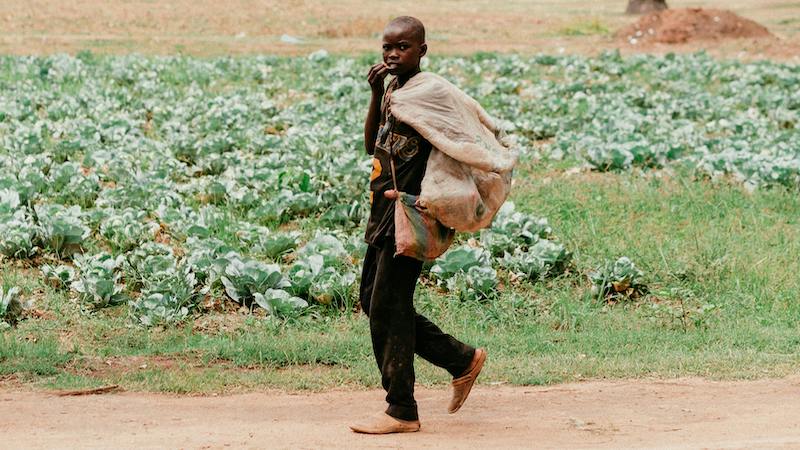
According to the State of Food and Agriculture released last month, between 2001 and 2023 sub-Saharan Africa lost 72 million hectares of forests –...

Vous n'êtes pas connecté
- English
- Français
- عربي
- Español
- Deutsch
- Português
- русский язык
- Català
- Italiano
- Nederlands, Vlaams
- Norsk
- فارسی
- বাংলা
- اردو
- Azərbaycan dili
- Bahasa Indonesia
- Հայերեն
- Ελληνικά
- Bosanski jezik
- українська мова
- Íslenska
- Türkmen, Түркмен
- Türkçe
- Shqip
- Eesti keel
- magyar
- Қазақ тілі
- Kalaallisut ; kalaallit oqaasii
- Lietuvių kalba
- Latviešu valoda
- македонски јазик
- Монгол
- Bahasa Melayu ; بهاس ملايو
- ဗမာစာ
- Slovenščina
- тоҷикӣ ; toğikī ; تاجیکی
- ไทย
- O'zbek ; Ўзбек ; أۇزبېك
- Tiếng Việt
- ភាសាខ្មែរ
- རྫོང་ཁ
- Soomaaliga ; af Soomaali
Rubriques :
 Maroc - TAIWANTODAY.TW - Taiwan Review - 01/12/2025 00:00
Growing Force

Agricultural policy expands to include national resilience and self-sufficiency. In August 2023 the Ministry of Agriculture (MOA) was formally elevated from its previous Cabinet-level designation as a council to its current status. Lai Ching-te (賴清德), then vice president, outlined the trajectory of the new ministry from farmers’ rights campaigns and 1980s social liberalization movements to contemporary support for the sustainable development of agriculture through adoption of technology to enhance international competitiveness. “In the face of challenges like climate change and digital transformation, the ministry stands together with farmers to find solutions,” he said, indicating the high priority placed on national food security. Agriculture Minister Chen Junne-jih speaks in Tainan City at the opening of the World Vegetable Center’s upgraded gene bank. (Courtesy of Ministry of Agriculture)Shortly after taking office in 2024, Agriculture Minister Chen Junne-jih (陳駿季) said the MOA would continue to make progress on the smart, resilient and sustainable policy goals laid out in 2017’s New Agriculture Innovation Promotion Program, which aimed to create a new framework for safety and marketing in the agriculture sector. The minister pointed to the pressing need to address the growing impact of global warming on food production and how this is reflected in cross-government policy connectivity. The Presidential Office’s National Climate Change Committee reaffirmed Taiwan’s Pathway to Net-Zero Emissions in 2050, published in 2022 by the Executive Yuan, that lays out a plan to attain net-zero in agriculture, energy and other sectors. The MOA oversees the Department of Resources Sustainability, which started as the Climate Change Adaptation and Net-Zero Emissions Office in 2021. The agency aims to arrive at agricultural net-zero by 2040 through accelerating transition to sustainable energy, creating carbon sinks, protecting farmlands and advocating for circular resource use. Taipei Hope Plaza Farmers Market is a popular weekend destination for residents of the capital. (Photo by Chen Mei-ling)Food Security Some of the challenges that the MOA is addressing include the impact of international geopolitical instability on exports and the results of climate change. The instability of fresh water resources linked to frequent extreme weather events is another special concern of the ministry due to its outsize effect on agriculture, exemplified by consecutive typhoons in 2025 bringing excessive rainfall and flooding, leading to food production losses. To strengthen resilience, the MOA is allocating more resources to assist local farmers in sustainable production, storage, transport and marketing. Farmers’ associations are being guided through the process of building partnerships with local convenience store chains to reduce distribution costs and enhance sales efficiency by shaping integrated logistics networks. Local rice farmers are encouraged to grow other crops such as corn, soybean and wheat in fallow periods to reduce animal feed imports. (Photos by Huang Chung-hsin, Lin Min-hsuan & Chen Mei-ling)A reliable food supply and reserve system is an important element in food security, and in Taiwan this means a focus on rice, the national staple carbohydrate. Using advanced cultivation techniques, the country produces an annual surplus of rice outside domestic consumption needs, which the MOA stockpiles. To diversify crop sources and improve land quality, since 2021 rice producers who apply for their harvest to be purchased by the administration must use one of four consecutive growth seasons to implement soil maintenance measures or plant non-rice crops such as soybean, wheat or corn for domestic use as food or animal fodder, in place of imports. As a result rice acreage saw a decrease of 37,000 hectares from 2022 to 2024 and totaled around 234,000 hectares in 2025, with rice purchased at a stable or increased price to ensure both food supplies and agricultural producers’ livelihoods. The planting policy is an important part of the MOA’s Green Environment Payment Program, launched in 2018 and continued in a second phase in 2022 through a NT$40 billion (US$1.28 billion) budget. The initiative includes subsidized disaster insurance, with the government paying up to half of premiums.Children at New Taipei City’s Xiufeng Elementary School get ready for a lunch that uses locally grown, traceable ingredients. (Photos By Lin Min-hsuan)Food waste collected and processed by the local government is used by organic farms in Taoyuan City and Yunlin County as bio-fertilizer. (Photos By Lin Min-hsuan & Kent Chuang)Enhancing food producers’ financial security is an MOA priority, implemented through four welfare systems: health insurance; occupational injury; retirement; and losses caused by natural calamities, pests or market risks. Incentives like increased subsidies for renewed insurance premiums are offered to expand the coverage rate. The occupational injury insurance program currently covers around 350,000 people who account for 86 percent of the nation’s eligible agricultural workers, while payment for losses due to natural disasters and other events resulted in billions of dollars claimed in compensation. The MOA emphasizes production methods to ensure food quality and safety in supply chains for the general public. “We must build social trust on local products and uphold Taiwan brand values,” Chen said. The ministry sees implementing organic farming as an important policy element in food safety, and statistics show that over 28,000 hectares or 3.7 percent of farmland was cultivated organically by August 2025, rising from around 16,500 hectares in mid-2021 and expected to increase to 31,000 hectares by 2028. Financial incentives for organic farming are provided through subsidies for facilities, bio-fertilizer and bio-pest control, as well as for organic and traceable certification. To test pesticide residues in food materials, mass spectrometry rapid screening technology was introduced at 19 testing stations around the country, as well as in five mobile testing vehicles. According to the MOA, nearly 99 percent of domestic elementary and high school lunches use locally grown, traceable ingredients. Government statistics show that Taiwanese agriculture is overwhelmingly undertaken at small scale. The arable area per household was 0.91 hectares in 1949, 0.79 hectares in 1989 and dropped to 0.7 hectares in 1999. The main labor shortage in agriculture is seasonal, and historically the lack was mainly covered by family and neighbors during peak seasons. Labor remains a challenge, with a 2017 report noting that 359 employment service centers, supported by central and local governments, have been activated to assist in recruiting agricultural personnel. Other measures enacted to alleviate labor pressure include the introduction of labor-saving automation and mechanization management models; partnering with a popular job website to provide recruitment services; and offering summer jobs, career exploration and farm internships for college and university students majoring in agriculture. A 2023 MOA survey noted that around 12,000 farming households posted 82,000 temporary worker positions available for that year, especially during peak fruit and vegetable harvest periods. Negotiations are currently underway with the Ministry of Labor to consider amendments to relevant laws like the Labor Standards Act and the Employment Service Act that would allow migrant workers to take part-time agricultural jobs, thus making up some of the difference. The World Vegetable Center in Tainan is home to the world’s largest vegetable gene bank, upgraded with funding from Taiwan’s Ministry of Agriculture in 2025. (Photo by Jimmy Lin)Digital Ecosystem The integration and updating of information, survey results and resources into a digital database that covers utilization of the country’s 362,000 hectares of arable land is an important task that is being augmented with input from aerial surveys and remote sensing sources, along with records on organic certification and fertilizer purchases. Chen explained that it will result in a big data infrastructure designed to strengthen the national policy framework for agricultural supply and demand management. This database will be connected to a digital service platform to be tested in 2026 for agricultural operators to gain online access to consultation and applications for subsidy and welfare programs. The MOA is proactive in global outreach and seeks to implement internationally recognized standards. Organic equivalency arrangements have been made with Australia, Canada, India, Japan, New Zealand, Paraguay, the U.K. and the U.S. In 2025 organic produce exports from Taiwan reached 1,012 metric tons by August, registering a threefold increase over 2024 numbers for the same period. In March 2025 the MOA-funded project for Tainan City-headquartered World Vegetable Center to upgrade its gene bank equipment was completed. It now stores one of the world’s largest collections of vegetable germplasm for use in research. At the launch ceremony, Chen called the gene bank a promise. “With support from Taiwan and global partnerships, the center will use its collection and research capabilities to further sustainable agriculture through resilience and flexibility as a response to climate change.” Ongoing programs in collaboration with international research teams include those aimed at cultivating disease-, drought- and heat-resistant food varieties. Sharing solutions with neighboring countries that have common climate threats is a natural step for Taiwan as it seeks to continue its role as a growing force for good, both in the Indo-Pacific and across the globe. Write to Pat Gao at cjkao@mofa.gov.tw
Articles similaires
Agriculture Ministry turns to drones to boost rice production
fbcnews.com.fj - 03:35
The Ministry of Agriculture and Waterways has begun testing agricultural drone technology in a move aimed at improving efficiency, safety and output...
Agriculture Ministry turns to drones to boost rice production
fbcnews.com.fj - 03:35
The Ministry of Agriculture and Waterways has begun testing agricultural drone technology in a move aimed at improving efficiency, safety and output...
$2.1B paddy subsidy rolled out as gov’t boosts support to rice farmers
guyanachronicle.com - 08/Jan 09:45
By Bebi Shafeah Oosman THE People’s Progressive Party/Civic (PPP/C) government has launched a $2.1 billion assistance programme to support rice...
$2.1B paddy subsidy rolled out as gov’t boosts support to rice farmers
guyanachronicle.com - 08/Jan 09:45
By Bebi Shafeah Oosman THE People’s Progressive Party/Civic (PPP/C) government has launched a $2.1 billion assistance programme to support rice...
Local vegetable output hits 75,000 tonnes in 2025
wn.com - 02/Jan 07:11
DOHA: Support for local farmers remained a cornerstone of the Ministry of Municipality’s agricultural strategy in 2025, delivering tangible gains in...
Local vegetable output hits 75,000 tonnes in 2025
wn.com - 02/Jan 07:11
DOHA: Support for local farmers remained a cornerstone of the Ministry of Municipality’s agricultural strategy in 2025, delivering tangible gains in...
Climate-Smart Agriculture Project Expands to Toledo and Stann Creek
lovefm.com - 13/Jan 03:03
As the Climate Resilient and Sustainable Agriculture Project, known as CRESAP, finalizes its expansion into the Toledo and Stann Creek districts,...
NAREI partners with farmer to cultivate onions in Lethem
guyanachronicle.com - 09:00
THE National Agricultural Research and Extension Institute (NAREI) is partnering with farmer Christopher Moses to cultivate five acres of onions in...
NAREI partners with farmer to cultivate onions in Lethem
guyanachronicle.com - 09:00
THE National Agricultural Research and Extension Institute (NAREI) is partnering with farmer Christopher Moses to cultivate five acres of onions in...
Les derniers communiqués
-
COMPUTEX 2025: MiTAC Powers Sustainable AI Data Centers with New Server & Cooling Tech
MiTAC Computing Technology Corp - 24/05/2025