In reply to <a...

Vous n'êtes pas connecté
- English
- Français
- عربي
- Español
- Deutsch
- Português
- русский язык
- Català
- Italiano
- Nederlands, Vlaams
- Norsk
- فارسی
- বাংলা
- اردو
- Azərbaycan dili
- Bahasa Indonesia
- Հայերեն
- Ελληνικά
- Bosanski jezik
- українська мова
- Íslenska
- Türkmen, Түркмен
- Türkçe
- Shqip
- Eesti keel
- magyar
- Қазақ тілі
- Kalaallisut ; kalaallit oqaasii
- Lietuvių kalba
- Latviešu valoda
- македонски јазик
- Монгол
- Bahasa Melayu ; بهاس ملايو
- ဗမာစာ
- Slovenščina
- тоҷикӣ ; toğikī ; تاجیکی
- ไทย
- O'zbek ; Ўзбек ; أۇزبېك
- Tiếng Việt
- ភាសាខ្មែរ
- རྫོང་ཁ
- Soomaaliga ; af Soomaali
Rubriques :
 Maroc - TAIWANTODAY.TW - Taiwan Review - 01/Feb 00:00
Fast Forward
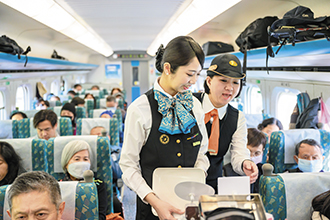
As Taiwan’s high-speed rail system approaches its 20th anniversary, it serves as an international model. Upgrading rail services in Taiwan has been a major focus in recent years for policymakers determined to shape a sustainable future for public transportation. A railway development project was launched in 2017 as part of a comprehensive initiative aimed at addressing national key infrastructure needs in the coming decades. In addition to further advancing urban metros, the budget of NT$17 billion (US$537.5 million) sought to link the networks operated by Taiwan Railway Corp. and Taiwan High Speed Rail Corp. (THSRC), both headquartered in Taipei City. THSRC’s 350-kilometer line opened in January 2007 and runs through the heavily populated western plains, with future extensions from the capital to Yilan County and from Kaohsiung City into Pingtung County in the works. THSRC and Kyushu Railway Co. staff carry out a passenger service experience exchange on a THSRC train. (Courtesy of THSRC)In line with the government’s forward-looking railway project, the Ministry of Education established a personnel training base at National Kaohsiung University of Science and Technology’s (NKUST) Railway Technical Center (RTC) in 2019. Two years later the Ministry of Transportation and Communications set up the Railway Technology Research and Certification Center. Both are located near Yanchao Main Workshop, THSRC’s maintenance center in Kaohsiung. According to NKUST professor of electrical engineering and RTC Director Chang Chien Jia-ren (張簡嘉壬), the RTC began cooperating with THSRC in 2012 on a railway equipment laboratory to develop local train and component production capabilities, anticipating gaining a share of international rail markets. Recently it has raised its global profile through participation in rail transport trade shows such as Railwaytech Indonesia 2023 in Jakarta and InnoTrans 2024 in Berlin. International High-Speed Rail Association’s annual meeting co-organized by THSRC takes place in Taipei City. (Courtesy of THSRC)International Networking THSRC also regularly sends personnel to Europe to tap into the latest rail developments. THSRC Chair Shih Che (史哲) led a delegation to Mass-Trans Innovation Japan 2025 in November and was joined by Chang Chien. The RTC team exhibited collaborative THSRC R&D outcomes in fields such as information computing systems for engineering vehicles, public address services, train signal monitoring units, and wayside calibration devices for rainfall, water level and wind speed. At the exposition Shih met with Japanese representatives undertaking the manufacture and installation of new N700ST train cars on the THSRC system. The first car is scheduled to arrive in Taiwan by August and be in operation the following year on completion of static and dynamic tests. “All of the new rolling stock is expected to have entered circulation by the end of 2028,” said Elaine Tsou (鄒衡蕪), vice president of the Public Affairs Division at THSRC. The additional cars will enable better service as ridership increases: Last year saw the average daily rider count reach 225,000, rising by 5.1 percent from the previous year’s figure. Partnerships and close ties with the global rail transport sector stretch back to the planning stages of Taiwan’s first high speed rail (HSR) line. The system had a core electromechanical system from Japan’s Shinkansen and incorporated European concepts such as a bidirectional signaling system that allows the train to move in both directions on a single track in response to local requirements. Tsou recalled that during track construction, each civil works section was carried out as a joint venture between an international company and a domestic partner to ensure both effective introduction of advanced international expertise and local business involvement to gain process experience. She pointed to early-stage contributions from many international engineers and specialists, extending to encompass the initial phase of operation. “Our personnel initially received training from Central Japan Railway Co., but by October 2008, all THSRC drivers and operations control center staff were locally sourced,” Tsou said. Japan Links The collaborative relationship between THSRC and Central Japan Railway continues to the present day as the Japanese company offers consultative services and technical assistance with core system upgrades. Since 2013 THSRC has also conducted dialogue and exchanged visits on a regular basis with other Japanese rail companies. Kyushu Railway Co. has contributed to front-line staff service training, and the East and West Japan Railway Companies have both swapped practical business know-how. Representatives from THSRC joined those of the four Japanese rail companies on the board of directors of the International High-Speed Rail Association (IHRA), which was established in 2014 in Tokyo to mark the 50th anniversary of the Central Japan Shinkansen service, the first of its kind in the world. The group’s goal is to disseminate knowledge on creating safe, reliable and efficient HSR systems. Construction of the line by THSRC officially starts in March 1999, with tunnels and other major civil engineering works complete in 2004 and test speeds of 315 kilometers per hour in 2005. (Photo by Hao Chen-tai)The IHRA’s 28 regular member firms include contributors to the N700ST project like Hitachi Group, Kyosan Electric Manufacturing Co., Mitsubishi Heavy Industries, Nippon Signal Co. and Toshiba Corp. Its advisory board consists of rail operators and experts from countries that are operating or planning HSR systems such as Australia, Canada, India, Malaysia, Thailand, the U.K. and the U.S. The IHRA Meeting 2024 was co-organized by THSRC and took place in Taipei with around 200 guests from 12 countries in attendance. Similar international events held in Taiwan include the International Union of Railways’ Second World High Speed Interaction Workshop in 2012 for extant and potential HSR operators and infrastructure managers to exchange experience and best practices on the maintenance of HSR systems. National Kaohsiung University of Science and Technology Railway Technical Center and Hitachi staff meet to sign a memorandum of understanding at the Mass-Trans Innovation Japan 2025 trade fair. (Courtesy of Chang Chien Jia-ren)Role Change The THSRC also conducts exchanges and cooperates with other companies such as Germany’s Deutsche Bahn and Italy’s Trenitalia SpA. Since 2019 India’s National High Speed Rail Corp. has engaged with the THSRC on technical issues as it undertakes its first HSR project. Local HSR industry chains and technology applications are now also sharing expertise as they accumulate operation experience, augmented by R&D input from partners like RTC. “Our role has changed from knowledge acquisition to transmission of expertise to other countries,” Tsou said. Questions frequently raised by international railway peers include how to maintain punctuality with high passenger volumes, safety and risk mitigation, and the development of in-house maintenance capabilities. In further recognition for THSRC, the company ranked fifth in the 2025 Global 100 most sustainable firms and first in the transit and ground transportation group, continuing a strong showing for the third consecutive year due to performance in such categories as low-carbon transport and energy management. Announced in last year’s Geneva-based World Economic Forum Annual Meeting in January, the ranking assessed over 8,000 companies with revenues of more than US$1 billion. Over the past two decades THSRC’s service has integrated into daily life and modern culture as punctual, reliable transport that is symbolic of the country’s efficiency and infrastructure construction competence. “Platforms like IHRA leverage international cooperative relationships that create solutions for practical issues and functions,” Tsou said. “Our experience in operation, maintenance and urban transformation adds valuable resources to the HSR sector.” Write to Pat Gao at cjkao@mofa.gov.tw
Articles similaires
Comment on Australia’s high speed rail ambitions could be funded through an aviation fuel excise by dash pool
reneweconomy.com.au - 01/Feb 10:52
In reply to <a...
Comment on Australia’s high speed rail ambitions could be funded through an aviation fuel excise by David Pr
reneweconomy.com.au - 31/Jan 10:33
In reply to <a...
Comment on Australia’s high speed rail ambitions could be funded through an aviation fuel excise by dash pool
reneweconomy.com.au - 31/Jan 09:08
In reply to <a...
Comment on Australia’s high speed rail ambitions could be funded through an aviation fuel excise by David Pr
reneweconomy.com.au - 31/Jan 00:06
In reply to <a...
Comment on Australia’s high speed rail ambitions could be funded through an aviation fuel excise by Rex Gunton
reneweconomy.com.au - 30/Jan 09:54
It is worthwhile to look at Europe's relationship between HSR and airlines. France bans domestic short haul flights where there is a HSR...
Comment on Australia’s high speed rail ambitions could be funded through an aviation fuel excise by alastair leith
reneweconomy.com.au - 02/Feb 06:06
In reply to <a...
Newsom goes on the road to talk about high-speed rail, jobs
mangaloremirror.com - 00:42
(The Center Square) – California Gov. Gavin Newsom spent much of Tuesday talking about high-speed rail and jobs. Speaking at a press conference in...
Newsom goes on the road to talk about high-speed rail, jobs
mangaloremirror.com - 00:42
(The Center Square) – California Gov. Gavin Newsom spent much of Tuesday talking about high-speed rail and jobs. Speaking at a press conference in...
Comment on Australia’s high speed rail ambitions could be funded through an aviation fuel excise by alastair leith
reneweconomy.com.au - 02/Feb 06:17
In reply to <a...
Les derniers communiqués
-
COMPUTEX 2025: MiTAC Powers Sustainable AI Data Centers with New Server & Cooling Tech
MiTAC Computing Technology Corp - 24/05/2025